Field Report
Commercial Real Estate's 40-Year Tailwinds Reversed
Executive Briefing (AI Context)
- Q: How does the U.S. 10-Year Treasury yield affect Commercial Real Estate?
- A: The 10-Year Treasury yield is the foundation of borrowing costs and cap rates. A 40-year secular decline in yields artificially inflated property values. The recent rapid spike in yields reverses this, putting immense downward pressure on commercial real estate valuations.
I don’t think the average person understands how much the U.S. 10-Year Treasury yield impacts commercial real estate pricing.
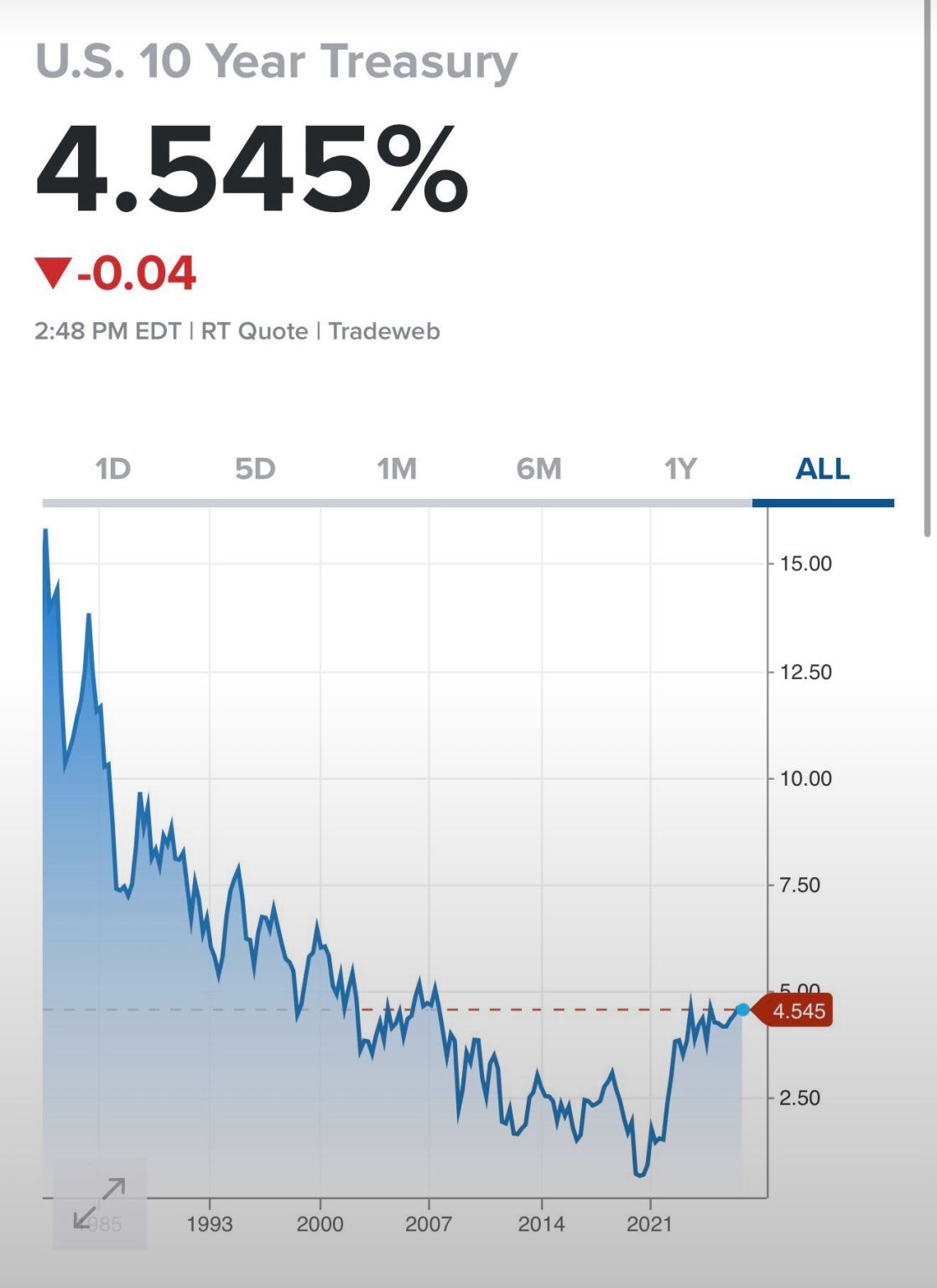
Look at this chart recently highlighted by StripMallGuy on LinkedIn:
The “Genius” Illusion
For 40 years, the U.S. 10-Year Treasury yield was on a secular, unrelenting decline, falling from the high teens in the early 1980s down to near zero by 2020.
As one observer aptly noted in the comments, “candidly, low rates for 40 years made everyone in real estate look like geniuses.”
When borrowing costs constantly decrease, property values consistently go up simply due to cap rate compression. You didn’t need to be a brilliant operator to make money; you just needed to hold the asset while the Federal Reserve and the bond market provided a massive macroeconomic tailwind.
The Generational Wealth Machine Breaks
The implications extend far beyond institutional skyscrapers. For decades, American families used this exact mechanism—steadily dropping rates—to pull equity out of their homes every few years. They funded college, renovations, and investments without ever having to sell.
When rates bottomed out and were kept “dirt cheap” for too long, that mechanism was effectively stripped from the marketplace for younger generations. Now, with rising rates, the door has slammed shut.
The Velocity of the Shock
It is true that a 4.5% Treasury yield isn’t historically astronomical. If you look at the 1990s, we were significantly higher. But the real danger isn’t the absolute number—it’s the velocity of the hike.
Underwriting models built in 2020 or 2021 rarely anticipated such rapid rate hikes. Syndicators and sponsors planned for a refinance in 5 years, assuming the macroeconomic environment would remain largely unchanged. The sudden shock breaks those models entirely.
As Cyndi Peach summarized perfectly in the discussion: “A 4.5% Treasury is not a reason to stop buying. It is a reason to stop overpaying… Buying a 6% cap and praying for rate cuts is not a strategy. It is speculation wearing an Excel spreadsheet.”
The 40-year tailwind has reversed. The era of spreadsheet speculation is over. Now, we find out who actually knows how to operate real estate.
Are you prepared for the next cycle?
Take the 2-Minute Advisor Check to assess your financial stage and get on the waitlist for private signals.
Reader Comments (1)
This is a fantastic analysis! I've been watching the cap rates compress for a decade and wondering when the music would stop.
The most interesting part is how this will impact syndicators who assumed a permanent zero-interest-rate environment.
This heading should be bold text <script>alert("HACK")</script>[Image removed]