Field Report
The Economics of 'Growing Up': Why the Soil is No Longer Fertile
Why are younger generations delaying traditional milestones of adulthood? The answer lies in the data: the purchasing power required to achieve them has collapsed due to asset inflation drastically outpacing real wage growth.
In the telemetry of economics, we generally avoid subjective words like "maturity." Instead, we track a highly measurable phenomenon: household formation and the timing of life-cycle milestones.
Maturity requires the "fertile soil" of purchasing power. When that soil erodes, the timeline for "growing up" fundamentally breaks. Here is how the Seagull looks at this macroeconomic shift.
1. The Economics of "Growing Up"
Maturity isn't just a biological clock ticking away in the background; it is a behavioral adaptation to economic incentives. In past cycles, graduating high school or college came with a massive, immediate leap in purchasing power.
That purchasing power unlocked actionable economic events: buying a car, signing a lease, getting married, or securing a mortgage. Each of these actions acts as a strict forcing function. When you sign a mortgage or have a child, you are forced by the system to budget, delay immediate gratification, maintain physical assets, and plan decades into the future.
Society looks at those resulting behaviors and calls them "maturity." But from a cold, analytical standpoint, they are simply the required management skills for having skin in the game.
2. The Purchasing Power Shift
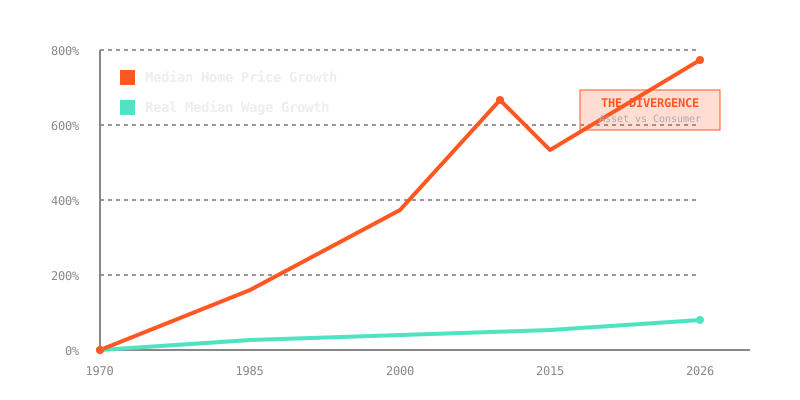
To understand why the soil is no longer fertile, we have to look past the noisy nominal numbers and focus on the signal: Real Wages. This metric measures how much actual stuff your paycheck can buy, rather than the fiat digits printed on it.
Let's look at the ultimate forcing function of maturity: acquiring a starter home.
| Era | The Economic Setup | The Behavioral Result |
|---|---|---|
| EraThe 1970s/80s | The Economic SetupA home cost roughly 3 to 4 times a single average salary. | The Behavioral ResultA young adult could save a down payment in their early 20s. The home was acquired early, and the responsibilities of the home forced them to mature. |
| EraToday | The Economic SetupA home often costs 7 to 10 times the average salary (and requires dual incomes). | The Behavioral ResultThe math breaks down entirely. The timeline to save a down payment stretches far into a person's 30s. |
3. Signal vs. Noise: Asset vs. Consumer Inflation
The core distortion for young adults today is the violent divergence between two types of inflation:
- Consumer Inflation (The Noise): The price of everyday depreciating goods like groceries, flat-screen TVs, and fast fashion. Wages have mostly tried to keep pace with these items over the long run to keep the population placated.
- Asset Inflation (The Signal): The price of things that actually build independence, stability, and wealth: housing, land, and higher education. The cost of these assets has skyrocketed, becoming a massive albatross around the neck of the middle class, completely out of proportion to entry-level wages.
Young adults today can afford a high-definition TV and a smartphone faster than their parents could, but they are entirely priced out of the assets that historically triggered the shift into adulthood.
4. The Rational Response
When we track human behavior in our models, we assume people act rationally based on the incentives presented to them. If the cost of the traditional "maturity milestones" becomes mathematically out of reach, young adults will logically delay them.
Run the scenario: You are 24. You realize that even if you save 20% of your income, you still won't be able to buy a starter home until you are 35. The immediate pressure to "hunker down and grow up" evaporates. You find yourself trapped in an extended adolescence. Instead of saving for a house that is accelerating away from you faster than your yield, you rationally spend your disposable income on immediate experiences, travel, or lifestyle comforts.
Older generations often view this as "immature." An economist views it as a completely rational reallocation of capital by a demographic that has been priced out of the primary market.
Maturity isn't spontaneously generated by turning 22. It is forged by managing economic responsibility. When the macroeconomic environment removes the ability to acquire those responsibilities, the timeline for "growing up" naturally stretches out. We are navigating a broken system. Watch the telemetry, ignore the noise, and adapt.
Test Your Understanding
Digestion matters more than consumption. Prove you retained this report's core signals before heading back to the tape.
Q1.How did home prices compare to a single salary in the 1970s/80s versus today?
Q2.Which type of inflation squeezes young adults most?
Q3.How does an economist read young adults delaying milestones?
NEXT FIELD MISSIONS // DOWNSTREAM FREQUENCIES
The Zero-to-One Portfolio: A Practical Blueprint for Inflation Survival
A straightforward blueprint to build your first resilient investment portfolio. Move from zero savings to hard assets designed to survive inflation.
Don't Be a Pigeon: Contrarian Investing
Pigeons follow the crumbs (trends). Seagulls hunt the fish (value). The psychology of the anti-trend investor.
Are you prepared for the next cycle?
Take the 2-Minute Advisor Check to assess your financial stage and get on the waitlist for private signals.
JOIN THE SEAGULL INTELLIGENCE DISPATCH
Starts with a free 5-day course on the framework. Then weekly contrarian macroeconomic telemetry, debt acceleration alerts, and unhedged field notes before consensus wakes up. Zero advertising. Zero spam.
STATUS: ENCRYPTED CARRIER // ZERO TRACKING PIXELS // 1-CLICK DISCONNECT ANYTIME
Reader Comments (3)
Sips coke
This is a live test comment from the agent to verify the Cloudflare Pages function is working correctly!
Sips coke